



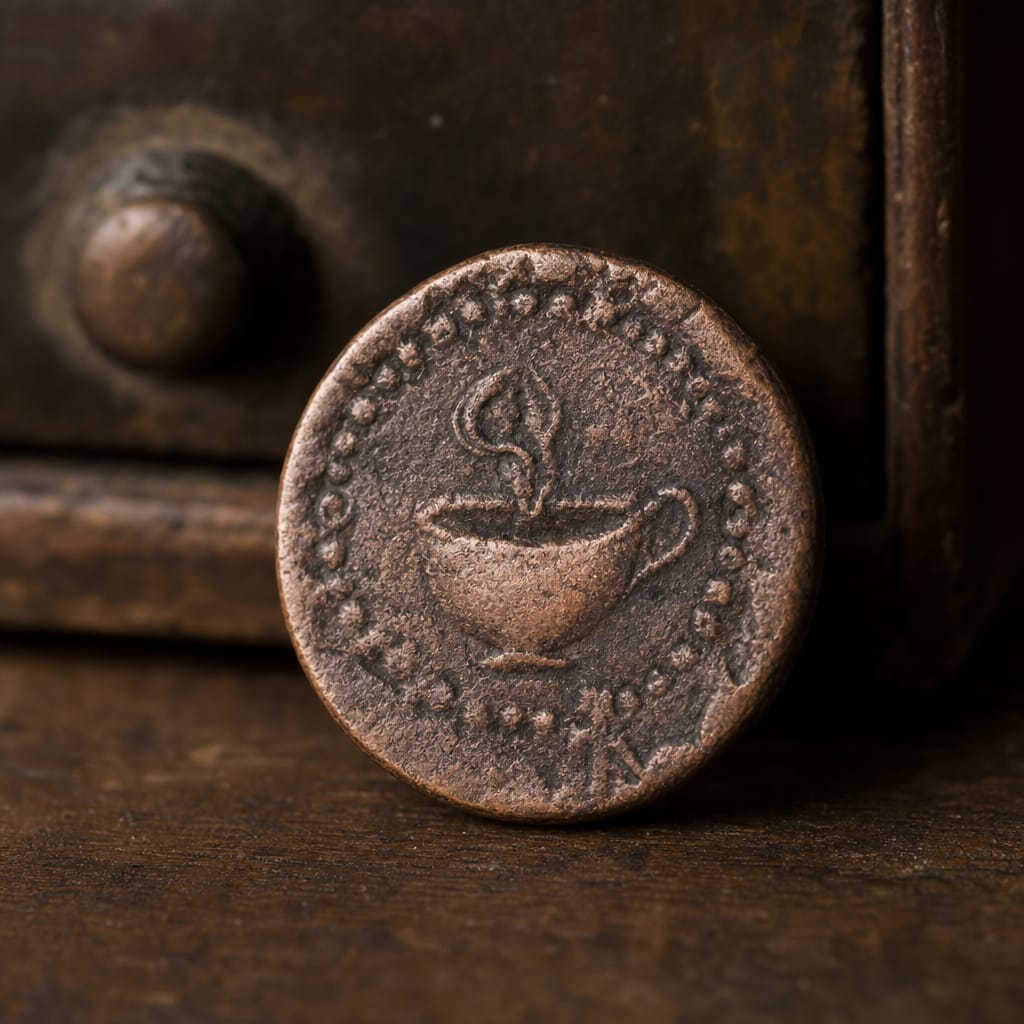
Museum collections in London hold small copper discs about the size of a shirt button, struck in the seventeenth century by coffee houses, taverns and shopkeepers. No king's face on them, no royal mint, no government authorisation whatsoever – just traders who needed a way to make change and decided to invent one. Their customers accepted them. That was enough. That was, it turns out, all it ever takes.
When people talk about Bitcoin as though it fell from the sky one morning in 2009 and broke the natural order of money, they are missing about four thousand years of context. Private money – currency issued by someone other than a government, worth something only because a specific group of people agreed it was – is not a strange new experiment. It is the default. Central banks are the newcomers.
The Original Token Economy
Long before Elizabeth I was fretting about clipped coins, merchants across medieval Europe were solving the same problem that Satoshi Nakamoto would eventually solve with a white paper: how do you move value between people who don't necessarily trust each other without a middleman who can be bribed, debased, or beheaded?
Their answer was bills of exchange, merchant tokens, and guild scrip – private instruments that circulated within a network of people who had agreed, collectively, to honour them. A Florentine cloth merchant's token meant something in Venice because other merchants in that network recognised it. Outside the network, it was a worthless bit of metal. Inside it, it was money. The value lived in the community, not the coin.
The British version of this got particularly creative. From roughly the 1640s through to the 1670s, there was almost no small coinage in circulation in England. The Crown wasn't interested in minting it, so tradespeople simply made their own. Bakers, tavern keepers, blacksmiths, and coffee houses across the country struck their own copper tokens and handed them out as change. Thousands of different issuers, each token valid more or less only in that street, that neighbourhood, that town. The whole thing worked because the people involved trusted the issuer. When the trust was there, the money worked. When it wasn't, it didn't.
Money Made of Wood
England had an even older system of money. For centuries the royal Exchequer recorded payments in a shared account on tally sticks, made by cutting notches in long pieces of hazel or willow. The pieces were split down their length so that each party could keep a matching half. The notches indicated the amount of money due and, because the two halves of the tally fitted together, the pieces of wood became a proof of a debt which could be passed on to someone else as a claim. The Exchequer stopped using tallies in the 1820s, and the burning of the leftover sticks in 1834 started the fire that destroyed the old Palace of Westminster.
The Truck Shop and the Controlled Economy
The darker chapter of private currency is the truck system, and you should know about it if you want to understand why governments have always been so keen to stamp this sort of thing out. Through much of the eighteenth and nineteenth centuries, many employers – particularly in mining and textile towns – paid their workers not in coin but in tokens that could only be spent at the company shop, the "truck shop". Same principle as the medieval merchant token: value within the network, worthless outside it. Except here the network was controlled by one party, who also set the prices. Parliament eventually banned it with the Truck Acts precisely because a private currency in the hands of an employer is a very convenient instrument of control.
That history is one reason governments tend to get nervous when parallel currencies start working well. It is not always that the currency is doing something wrong. Sometimes it is just that it is doing something right, outside official channels.
Tokens in the Mill Towns
Truck tokens and wages paid partly in the form of tokens or credit, to be spent in the employer’s shop, were found in many of the industrial towns of Britain, including the textile towns of Lancashire. The Truck Act of 1831 required wages to be paid in coin of the realm, and later Truck Acts were framed with the object of preventing payment of wages in money of the employer’s own making, with which employees could not purchase goods elsewhere than in the employer’s shop.
A Wallet Address Today
Which brings us to the bit with the phone app and the terrifying price charts. When you buy Bitcoin or Ethereum or any of the longer-tail coins, you are joining a network. The coin is worth what the network agrees it is worth – not because a central bank decreed it, not because there is gold in a vault somewhere (there isn't, and there hasn't been for most people's lifetimes), but because a sufficiently large group of people have decided to honour it as a store of value. This is exactly what made a coffee-house token work in the 1660s. The technology is completely different. The social mechanism is identical.
That does not make crypto safe, obviously. Networks collapse – they always could. When a token's issuer closed, its tokens became worthless overnight; medieval merchant networks fractured during plagues and wars; the truck shop token became toilet paper the moment the mill shut. Volatility is not a bug introduced by Bitcoin. It is what private currencies have always done when the trust holding them together wavers. For buying crypto in the UK, exchanges such as CoinJar or Gemini will walk you through the practicalities of setting up a wallet and making a first purchase. Crypto is high risk, so check that any firm you use appears on the Financial Conduct Authority register before you hand over money.
What you are really buying, when you buy crypto, is a membership in a particular agreement about value. That agreement is newer than your phone and older than your country.
Updated October 2026: we removed an unverified story about one particular coffee-house token, corrected how we describe crypto exchanges, and added material on tally sticks and truck tokens.
FAQ
What were the copper tokens used in seventeenth-century England?
Tokens as small change were issued by tradesmen in copper between about the 1640s and 1670s. At that time in England there was virtually no small change in circulation because the Crown was not interested in minting it. Bakers, tavern keepers, blacksmiths and even coffee houses issued their own currency, which would be generally accepted within the vicinity of the issuer.
What were tally sticks?
Tally sticks were pieces of hazel or willow split lengthwise with notches, used by the royal Exchequer to record payments. Each party to a payment would receive a matching half of the stick, which could then be used as evidence of a debt, or as a means to pass on a claim. They were last used by the Exchequer in the 1820s.
Why did Parliament ban the truck system?
The truck system was outlawed by Parliament because a private currency controlled by an employer is a useful tool of control. Workers were paid in tokens which could only be spent at the company shop and prices there were at the mercy of the employer. The Truck Act of 1831 required that all wages be paid in coin of the realm.
Is buying crypto safe in the UK?
No, crypto is high risk – its value is based on a network of people continuing to trust it, which can fail and bring all the associated tokens to zero. Before buying crypto in the UK, make sure any company you use is listed on the Financial Conduct Authority register before parting with your cash.