
Think back to early 2009. The news was all about banks going under and mortgage holders in freefall. The phrase ‘staycation’ had just been introduced to the British public as though sleeping in your own garden was some kind of aspirational lifestyle choice. To coax terrified consumers off the sofa, travel companies were cutting prices and slashing packages. The luxury end of the market, you might assume, was in the same boat – only with nicer towels.
No. The very top tier of luxury travel – private island rentals, Botswana lodge camps and hotel residences that do not put their prices on their websites – either held firm or quietly got more expensive. Waiting lists stretched. Availability tightened. The 2008 crash, far from wiping out high-end travel, seemed to polish it.
This is not a coincidence. It's a pattern with a name.
The Hourglass That Appears When the Economy Shakes
What is more, severe economic stress does not result in the entire luxury market plummeting. Instead, it is reshaped into an hourglass and the “middle” collapses. These are consumers who have been stretching themselves, treating themselves, spending slightly outside their comfort zone. When money tightens, they retreat and the premium/luxury-ish category falls.
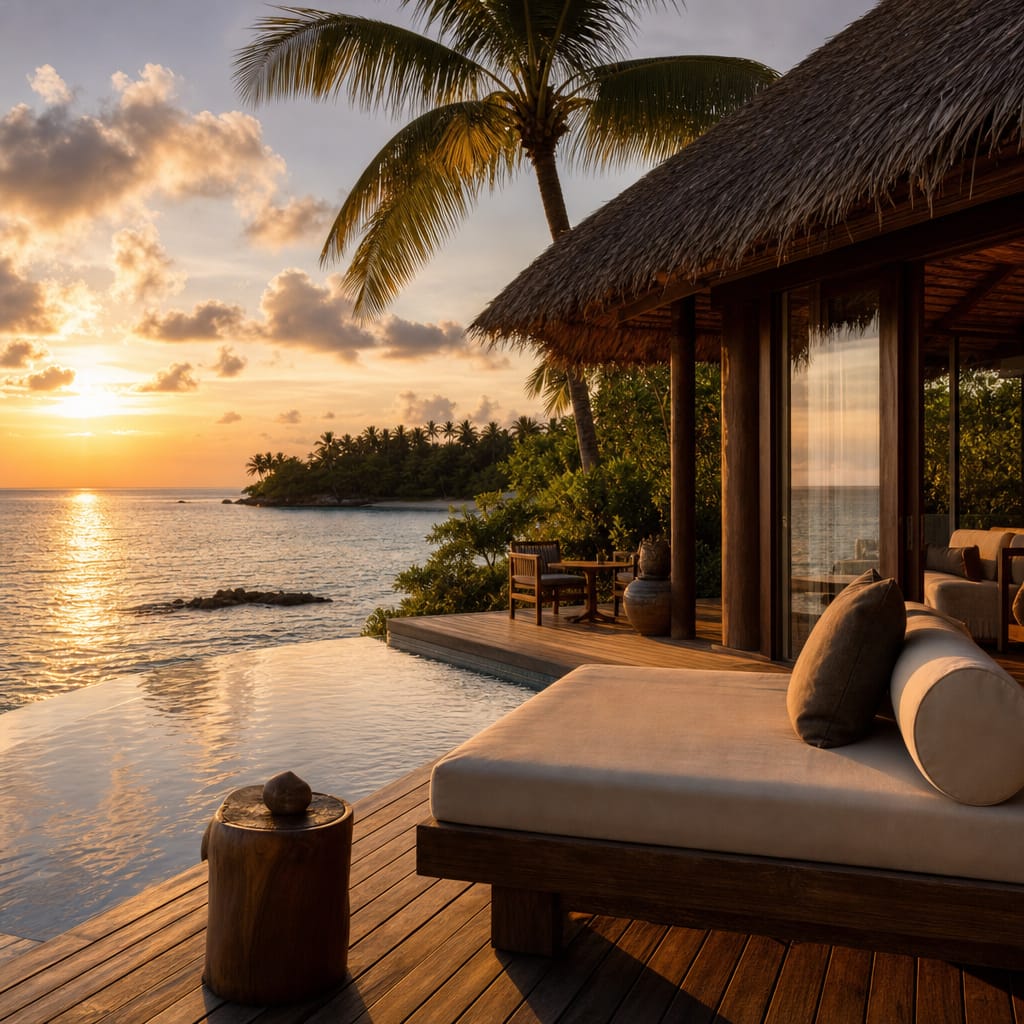
Conversely, the very top hardens: prices hold, and sometimes they rise. Occupancy rates at genuinely ultra-high-end properties have remained remarkably resilient through downturns, including the 1973 oil crisis, when transatlantic leisure travel cratered but certain categories of exclusive travel barely blinked. This also held true following 2008 and again during the 2022 inflation spike, when a friend of yours was probably cutting back on restaurant meals at the same time as the Maldives was reporting some of its strongest booking seasons on record.
Why the Very Expensive Thing Behaves Backwards
There’s a reason that genuine luxury isn’t a point on the quality scale: it’s actually a different kind of purchase that plays by inverted rules.
Most things we buy are what economists call normal goods. When your income drops, you buy less of them. And when you do buy them, you buy the cheaper version. So a good bottle of wine becomes a cheaper wine, a hotel becomes a B&B and the flight becomes a coach seat. All this is rational behaviour under financial pressure.
But at the very top end, something else is happening. Whilst lying on a beach is part of the experience, the ultra-expensive holiday isn't primarily being bought for that. In part it is being bought because of what it signals, to your peers, to your industry, to yourself. In dry economics language, these are Veblen goods: their desirability is inseparable from their price. And if you make them cheaper, they become less attractive. Their very expensiveness is part of the product.
So when everyone around you is cutting back, you don't feel less inclined to go. If anything, the contrast makes the purchase feel more meaningful, not less.
What the Crash Revealed That the Brochure Never Said
Recessions teach you something genuinely interesting: they act as a stress test that strips away the marketing language and shows you what a product actually is and who it serves.
In normal times, “luxury” is applied with extraordinary looseness — to an upgrade, a boutique guesthouse, a business-class seat, a hotel with particularly aggressive scatter cushions. It's slapped on anything that costs more than average and comes with a fluffy dressing gown.
A recession separates that out. The fluffy dressing gown tier evaporates or cuts its prices to survive. What remains untouched (and sometimes thriving) is the category that was never really in the same market to begin with. It was always a different economic object, dressed in the same word.
Which is perhaps worth bearing in mind when searching for a luxury holiday and wondering why the price range runs from £800 to £80,000. They are not the same thing with different levels of thread count. In economic terms, these are almost entirely unrelated purchases that happen to share a label.
FAQ
Why do luxury holiday prices hold up during a recession?
The highest-end purchases behave differently from most other goods at the very top of the price scale. These are Veblen goods. Demand for most goods falls as price rises, but with Veblen goods the reverse is true – as others cut back on expenditure, such high-end holiday purchases may seem more worthy, not less.
What is a Veblen good?
A Veblen good is something for which desire increases with price. So a Veblen good actually becomes less desirable if it is offered at lower prices, because its expensiveness is part of what is being bought. This is why an extremely expensive holiday can be more attractive as others about you are cutting back on expenditure. An extremely expensive holiday is also purchased for what it signals to the peer group and industry of the buyer as well as what it signals to the buyer himself or herself, not just for the beach.
What is the hourglass effect in luxury travel?
It describes how a severe downturn reshapes the luxury market, so the middle segment collapses while the top end holds up. Over-stretched consumers who were purchasing luxury to treat themselves can no longer afford to do so in times of financial restraint. As a result, the premium-ish category falls while the very top end hardens, with prices holding and sometimes even rising, as they did after 2008 and through the 1973 oil crisis.
Why does a luxury holiday cost anywhere from £800 to £80,000?
The term ‘luxury’ is a label covering a multitude of unrelated purchases. In many cases ‘luxury’ is used loosely to refer to items that are above average in price. Sometimes these are upgrades to everyday products and on other occasions they are boutique guesthouses. A recession separates these: the lower tier cuts prices or disappears, while the top tier was always a different economic object. They are not the same product with different thread counts.