





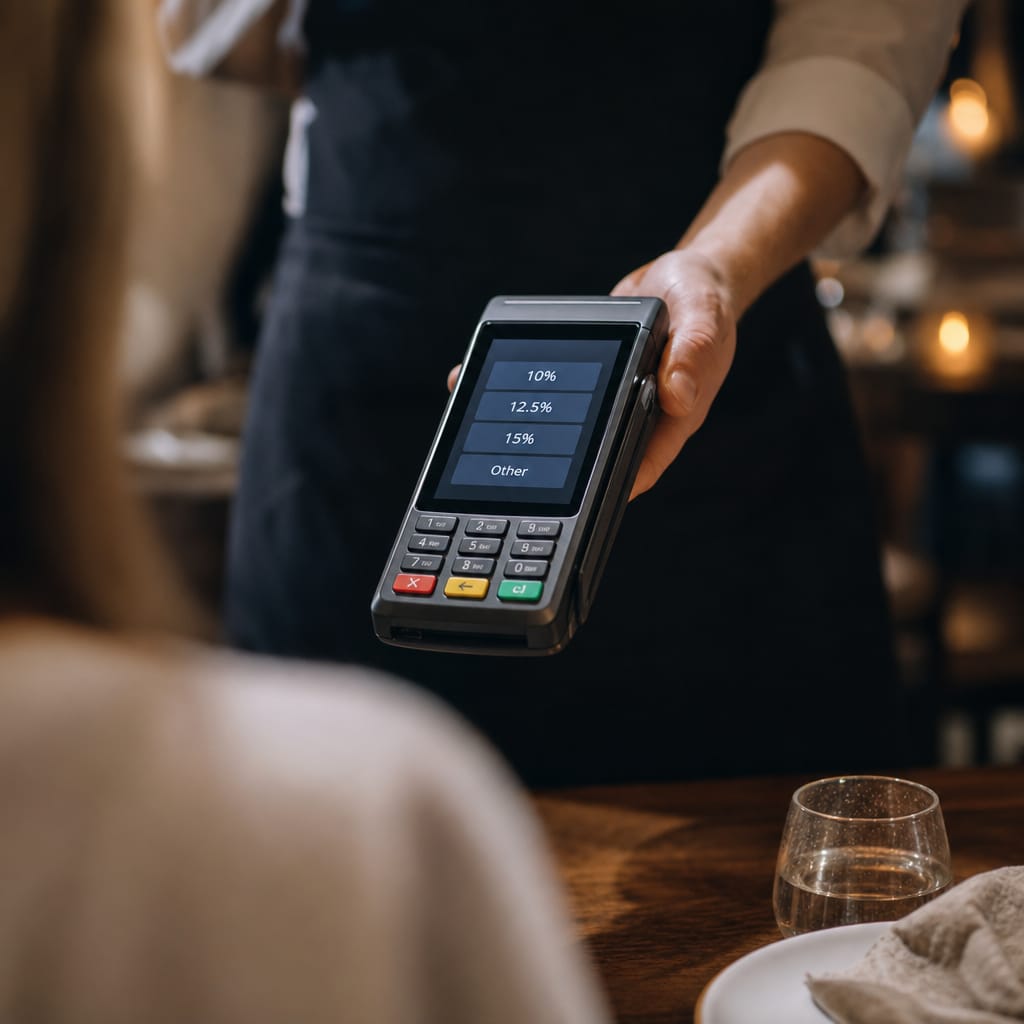
Everybody knows the feeling. The meal is done, the plates are gone, and in walks the waiter with the little machine, which he tilts towards you. On the screen there are three options: 10%, 12.5%, 15%. And a fourth button that essentially says, “I am a monster.” You jab one of them, you’re not sure why you’ve done what you’ve just done, and then you hand the machine back and spend the next ten minutes or so quietly recalculating whether you did the right thing.
This isn’t a personality flaw. It’s a cultural hangover from a very specific moment in British history which most people have no idea happened.
When the Bill Took Care of Itself
For most of the twentieth century, British people didn't tip, not the way Americans did. A tronc (a French word) was the system that ran underneath most British restaurants and hotels from the 1950s onwards. This was essentially a mandatory service charge, added to the bill as a fixed percentage (usually 10% or 12.5%). It all got pooled together and distributed among the staff according to the management's formula. The individual diner had no say in who got what. And the individual waiter had no particular claim on any one table's goodwill.
No one felt guilty or felt they had to be generous. The transaction had been settled, the arithmetic done, and both parties got to go home without any lingering moral weight. And that was fine.
Leaving an extra few coins for a specific person – quietly, personally, as a signal that you thought they were especially good – was considered slightly odd. A bit American. It was all so showy, in a way that made the British wince.
Deregulation and the Death of the Tronc
By the 1980s, the British restaurant trade was to be deregulated, part of the broader loosening of commercial rules across that decade. Formal, managed service charges stopped being standard practice for many restaurants. Some kept them, some dropped them entirely. Others added a service charge to the bill as an optional line diners could technically remove, which introduced a whole new layer of social anxiety nobody had asked for.
And then there was the American model of the personal, discretionary tip, left freely, for whoever served you, based on your own private judgement of how good they'd been. In America this had centuries of logic behind it – a whole social understanding about what the numbers meant, what was rude, what was generous, what was normal. The custom arrived here without the manual.
For a good recommendation on tipping etiquette across different countries if you travel, the UK Government's foreign travel advice pages carry useful notes on local customs.
The Moral Arithmetic Nobody Taught Us
There is a low-grade anxiety that a generation of British diners has been quietly carrying ever since. Tipping of a personal, discretionary kind is not really about money, it's a verdict. You are being asked to rate the experience of another human being and express that rating in pounds, in front of them, using a machine they are holding. No wonder people freeze.
The class confusion is real too. The old tronc system was impersonal enough that it didn't require you to place yourself anywhere on the social map. The new system asks you to be the kind of person who tips generously, and in being asked, immediately makes you wonder what kind of person you actually are. 10% says something. 15% says something else. Leaving nothing at all, even when the service was genuinely poor and you have every right, requires a small act of courage most British people would rather avoid entirely.
What the Card Reader Inherited
The physical object of the card reader is where all this confusion has been passed to. The three percentage buttons on the screen were not arrived at by any great social consensus. They were put there by the software designers and the restaurants, calibrated roughly towards American norms, dropped into a British context that still hasn't quite processed them.
The 2023 Employment (Allocation of Tips) Act, which came into force in 2024, now legally requires all tips paid by card to be passed on to workers in full – so at least the question of whether your 12.5% reaches the person who served you has a clearer answer than it once did.
But the question of whether you're a good person for pressing that button? That one, the 1980s left entirely unresolved.
FAQ
What was the tronc system in British restaurants?
The tronc was a pooled system, used in many British restaurants and hotels from the 1950s onwards, whereby a mandatory service charge added to customers’ bills was distributed amongst staff according to the dictates of the manager or owner of said restaurant or hotel. This would typically be 10% or 12.5% and would be split amongst staff as the manager saw fit, with diners having no say. It was generally considered to be somewhat odd to leave additional personal tips on top of the tronc.
Why did tipping become awkward in Britain?
Deregulation in the 1980s led to the end of the managed service charge as the norm in many restaurants. The American custom of discretionary tipping of individual staff members began to be practised without any clear guidelines. Customers were suddenly expected to rate the service of individual staff members in pounds, in front of them. Sometimes optional service charges were added to the bill, causing further embarrassment.
Do card tips have to be passed on to staff by law?
Tips paid by card have to be allocated in full to staff under the Employment (Allocation of Tips) Act 2023, which came into force in 2024. It clarifies whether your 12.5% goes to the staff member who served you. Your guilt at pressing a button of your choice is not absolved by this legislation.
Why do card readers suggest 10%, 12.5% and 15% tips?
There is no social norm around how card reader percentages are set. These are typically set by the software designer or the restaurant and are usually based on the American model. So far, the British model has not fully developed in this respect. Typical options include 10%, 12.5% and 15%, so the buttons reflect design choices rather than etiquette.