




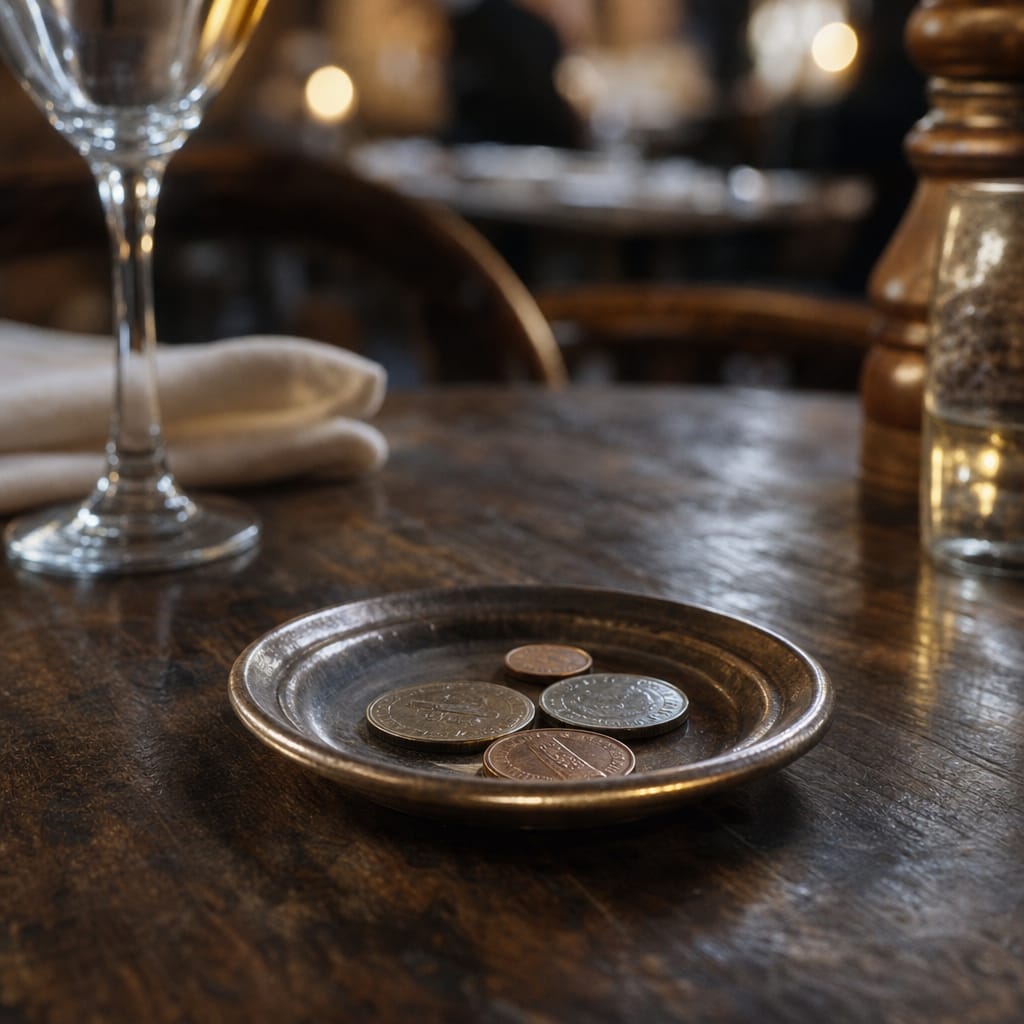
Before anyone printed a suggested service amount at the bottom of a bill, there was no arithmetic involved in tipping at all. A diner in Victorian London who wanted to reward their waiter didn't think in percentages. They thought in coins. You felt the weight of what seemed right, placed it on the table, and left. The gesture was social, not mathematical. Nobody was checking your working.
Which makes it rather odd that we now stand at a card reader doing mental long division under mild pressure while a server stares politely into the middle distance.
The percentage tip is a surprisingly recent import. And the figure you end up choosing – 10%, 12.5%, 15%, or whatever the screen nudges you towards – wasn't arrived at by measuring how grateful anyone felt. It was arrived at by measuring something far more prosaic: what restaurants needed to cover their wage bills.
How the Coins Became a Calculation
The word "tip" is old enough that its origin is genuinely contested, which is always a sign it predates careful record-keeping. What is clear is that for most of its life, the tip was a discretionary gesture with no standard unit attached. In British coffee houses and inns, you gave what felt appropriate for the room, the service, and your own sense of standing. Sailors and merchants tipped by instinct. Aristocrats tipped lavishly as a kind of performance. Most people tipped small and nobody expected otherwise.
The percentage entered the picture in America, somewhere in the early twentieth century, as restaurant dining became a middle-class habit rather than an elite one. When you have millions of people eating out rather than thousands, you need a norm. You can't leave it to individual instinct because individual instinct varies wildly and creates enormous tension between diners and staff. A number was more comfortable than a judgement call. And 10% was round, easy to calculate, and comfortably within most people's means.
It crossed the Atlantic gradually. British restaurants in the post-war decades began listing a "service charge" on bills partly because the law allowed them to collect it as revenue, and partly because it was tidier than hoping for coins. 10% became the quiet British standard through the 1970s and 1980s – largely because it was the American standard and American dining culture had enormous influence over what a modern restaurant was supposed to look like.
The Number That Kept Getting Bigger
Then the figure started creeping upward, and this is where it gets interesting. The move from 10% to 12.5% – which became standard at a huge number of London restaurants by the 1990s and 2000s – wasn't driven by diners becoming more generous. It was driven by rising labour costs in cities and by restaurateurs working out that a printed "optional" service charge was the most frictionless way to cover them. 12.5% wasn't a measure of satisfaction. It was a staffing calculation dressed up as a social norm.
The same logic explains why the suggested percentages on American card machines started nudging towards 18%, 20%, even 25% after the pandemic. Running costs went up. Menus couldn't absorb all of it. And the tip prompt on the screen absorbed the rest – quietly, while you were still deciding whether to have the cheesecake.
What You're Actually Measuring (Spoiler: Not Gratitude)
There's a large body of research – mostly American, since they've been studying this the longest – suggesting that tip size correlates very weakly with service quality. It correlates much more strongly with bill size, table size, weather, whether the server introduced themselves by name, and whether the mint arrived with the bill. Which is to say: the number you choose is far more about social ritual and cognitive shortcuts than about carefully calibrating how you felt about the pasta.
The percentage tip does a very good impression of measuring something meaningful – your personal assessment of service – while actually measuring the price of what you ordered, multiplied by a number that a restaurant industry decided upon for operational reasons a hundred years ago.
None of which means you shouldn't tip, or that the person who brought your food doesn't deserve the money. They almost certainly do. But next time the machine offers you 10%, 15%, or 20% and asks you to choose in three seconds, it's worth knowing those options weren't designed around gratitude. They were designed around cash flow. The feeling of generosity, though – that bit, at least, you still supply yourself.
FAQ
Where did the percentage tip come from?
The practice of percentage tipping in America originated in the early 20th century when eating out became a middle-class activity rather than an activity of the elite. As the number of diners across the country reached millions, a shared practice was needed as individuals’ natural propensity to tip varied greatly. Ten per cent was a round figure that was easily calculated by diners and was generally considered to be affordable by most of them.
Why did the standard service charge in London restaurants rise from 10% to 12.5%?
The main reason it rose was the rise in labour costs in urban areas, not more generous diners. By the 1990s and 2000s, an optional 12.5% service charge had become the norm at a huge number of restaurants across London. Print it at the bottom of the bill and customers know exactly how much they have to pay, which for restaurateurs was the most frictionless way to cover those costs.
Does the size of a tip reflect the quality of service?
Not very. Studies on tipping have largely been conducted in the U.S. and found that the size of the tip only weakly correlates with quality of service. However, there are many stronger correlates of the size of a tip including size of the bill, number of people at a table, weather, whether or not the server introduced themselves by name, and whether or not they brought the mint with the bill. The number you choose to tip is largely based on social ritual and cognitive shortcuts.
Why do card machines now suggest such high tip percentages?
The amount that is shown as the suggested tip on American card machines has gone up since the pandemic, often 18%, 20% or even 25%. This is because of the increased running costs of restaurants, and although menus can’t take the whole hit of these increased costs, the amount that is left can be absorbed by the option of paying a higher amount of tip at table. This is a cash flow option and is not given because the staff are thought worthy of thanks, though the staff almost certainly still deserve the money.