


The news comes through at half eight on a Tuesday morning. Unemployment is up and businesses are closing. The supermarket queues are long and anxious, and people are struggling, visibly. But then you glance at the financial pages and the stock market is going up.
This keeps on happening, baffling people again and again. There's an assumption most of us carry around that the stock market is some kind of national mood ring, a giant thermometer measuring how well the economy is doing right now. When things are bad, the stock market falls. When things are good, the stock market rises. Logical enough. And almost entirely wrong.
What the market is actually doing is something much stranger, and once you see it, you can't unsee it.
The Room Full of People Betting on Tomorrow's Money
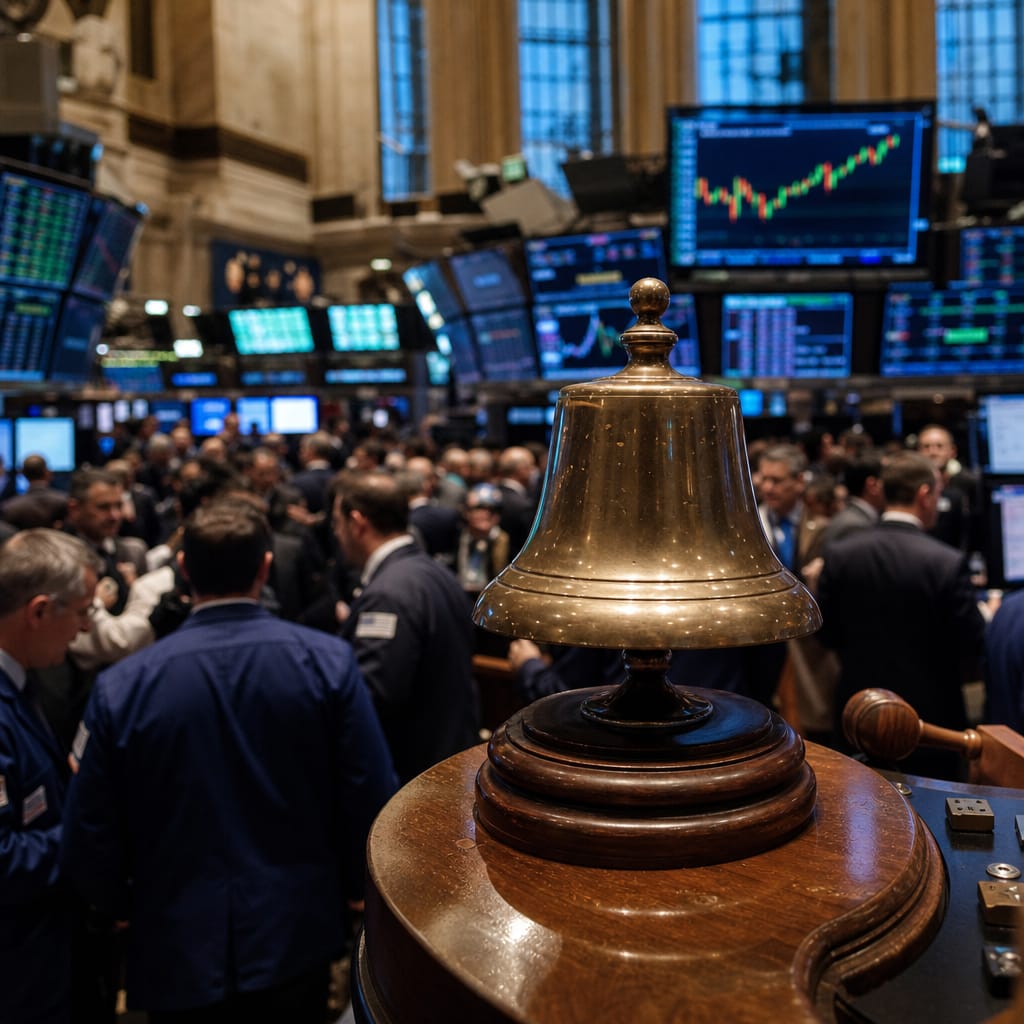
Imagine an auction room but instead of paintings or antique clocks being sold, what is being auctioned is the future purchasing power of cash. Each share that is bought and sold in the room is a slice of ownership in a real company such as a factory, supermarket chain or pharmaceutical business, something that makes or does actual things in the physical world. Rather than bidding on what the company is worth today, you are bidding on what your money will be worth tomorrow, relative to owning a bit of a real thing.
That's the key. Shares are claims on real assets. Cash is just cash.
Why Inflation Makes the Market Go Up (While Everything Else Goes Wrong)
When inflation hits – when the pound in your pocket quietly starts buying less than it did – then sitting on cash becomes a slow loss. The money you hold is melting. But a share in a company that owns warehouses, machinery, intellectual property, or a brand that people trust? That real stuff holds its value in a way that paper money doesn't. So investors are moving out of cash and into shares, not because anyone's feeling cheerful about the economy, but because owning a bit of something real is better than watching your savings erode.
Markets look almost obscenely chipper during inflationary crises that are genuinely hurting ordinary people. But they’re not celebrating. They’re just doing the maths on what’s worth holding.
The reverse works too. Deflation – when prices fall and cash gets relatively more valuable – can make markets look glum even when the economic data seems fine on the surface. If money is getting stronger, why swap it for a share? So we get the odd spectacle of healthy-looking output figures sitting alongside a market that’s quietly losing its nerve.
The Recession That Ended Before Anyone Noticed
Perhaps the strangest trick that markets play on us is recovering from recession before the recession is officially over – sometimes months before any government or economist has admitted the worst is over.
It’s not coincidence or luck. The market has never been about the present. It’s an auction where people make guesses about how things will be in 6, 12 or 18 months and price shares accordingly. If enough of them think this is probably the floor and that things will likely be recovering by spring, they’ll start buying, prices rise and the market lifts. All the while the headlines will be full of job losses and business failures, because those are real and present and awful. The market looks callous and disconnected, and in a sense it is. It’s playing an entirely different game.
A recession typically gets officially declared after two quarters of negative growth. By definition, that announcement is looking backwards. The market, for all its faults, is looking forwards – not measuring how bad things are, but running a continuous, messy, crowd-sourced bet on when things will be less bad.
What It Actually Is, Once You Stop Expecting It to Be a Thermometer
The stock market is not wise, it's not fair and it's not a reliable guide to anything in particular. It's often panicky and irrational. The market can get the future spectacularly wrong but, once you stop expecting it to reflect the present, the market makes a strange kind of sense.
The stock market is not a barometer of the economy, it’s an auction of the future, specifically an auction shaped by what people expect money itself to be worth later. And so, in a crisis, the market can look like it's lost its mind, because it’s answering a completely different question to the one everyone else is asking.
FAQ
Why does the stock market go up when the economy is struggling?
The market looks to the future and not the here and now. Investors bid on the expected value of money in the future versus buying a portion of a real company. Hence prices can rise in expectation of recovery within 6, 12 or 18 months, even amid gloom in the press with losses of jobs and failures of companies.
Does inflation make shares go up?
Yes, often. With inflation eroding the value of cash over time, it’s usually better to hold assets that have real value – the warehouses, machines, intellectual property and trusted brands associated with individual companies. Share prices rise as investors seek safe harbours for their cash rather than express optimism about the outlook for the economy as a whole.
Can the stock market recover before a recession ends?
A recovery from a recession can start before the official end of the recession, even months earlier. Investors price stocks on the basis of their expectations for the company’s development over the next 6, 12 or 18 months. Thus, the official announcement of a recession, after two consecutive quarters of negative growth, comes after the event has already occurred. In the meantime, the stock market has already made its bets on when the bottom will be reached.
Can deflation make the stock market fall?
Deflation can also make a healthy set of data figures look rather gloomy when translated into stock prices. In deflation, prices fall and investors perceive that cash is becoming more valuable than shares. Output figures remain healthy whilst the stock market becomes increasingly nervous.