





Somewhere between midnight and the first grey light of a Tuesday, a woman in Dhaka is pressing seams. The room she's working in is about the size of a medium Tesco, lit by the kind of fluorescent strip that makes everyone look slightly ill. She has done this particular motion – iron down, release, shift the fabric, iron down – several thousand times already tonight. By the time you scroll your phone over breakfast and tap on the "New In" banner of your favourite fast fashion site, the blouse she finished eight hours ago is already at a fulfilment warehouse in the East Midlands. The label says it was designed in London. In a loose sense, that's true. But it was made in the dark.
This is not an argument about ethics, or at least not primarily. It's about something more literal: the fact that the clothes on British high streets and homepages are, structurally, a product of the night shift, and that the supply chain is quietly engineered around time zones the way a relay race is engineered around a baton.
The Maths That Makes a Night Shift Necessary
The next-day delivery promise – the one that has gradually gone from luxury to expectation over the past decade – has a hidden underside. For a garment ordered on a Monday evening to arrive on a Tuesday, it cannot be sitting in a warehouse waiting. It has to be produced, quality-checked, folded, bagged, labelled, and dispatched. The only way to achieve that at a price the British market will pay (which is not very much) is to begin production at a time that accounts for the gap between Dhaka and Derby. Bangladesh is six hours ahead of GMT. Vietnam is seven. China, depending on the city, is eight. A factory beginning a production run at 10pm local time is feeding into a British working day that hasn't started yet.
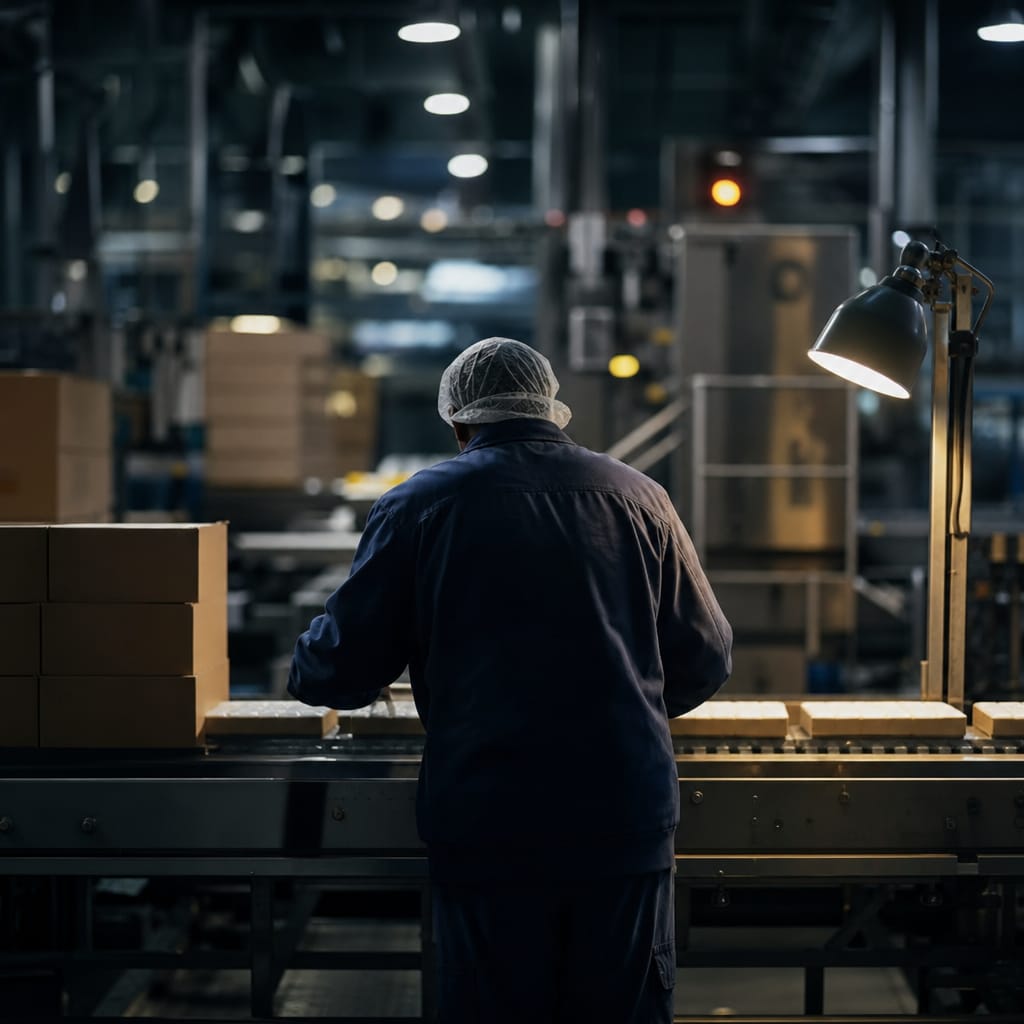
That time-zone gap is not a side effect. For the procurement departments of the big fast-fashion retailers, it is a feature. The overnight quota – usually set the previous afternoon by someone in an office in Manchester or Stockholm – determines what the finishing room in Ho Chi Minh City produces between 11pm and 5am. The workers doing it are called finishers, and their work is almost entirely by hand: clipping loose threads, pressing creases, attaching the final labels, checking buttonholes. This is the part of garment-making that cannot yet be automated at scale, which is why it is done by people, at night, in large numbers.
The Room the Label Never Mentions
A finishing room in a large Guangzhou factory during a peak season run is a strange and specific thing. Rows of workers, mostly women, mostly young, each with a small task in a longer chain. One clips. One checks seams under a light box. One folds to a template so the garment lands in the poly bag at exactly the same dimensions every time. The lights do not dim. The shift changes happen at 3am and again at 6am. The quota board on the wall is updated every two hours.
By morning – local morning – the finished garments are boxed and on a truck. The box is at a port within twenty-four hours, on a container ship within forty-eight, and inside an automated warehouse in the Midlands within the fortnight. The "just arrived" label it gets when it hits the rail is not wrong, exactly. It just tells you nothing about the chain of events that makes "just" possible.
What the Label Is Actually Keeping Quiet
Country of origin labelling is legally required in the UK, so the tag will say "Made in Bangladesh" or "Made in China". But it says nothing about when. Nothing about the finishing room at 3am, the presser doing her ten-thousandth seam of the night, or the specific overnight production quota that the blouse was born out of. The economics of fast fashion rest on a nocturnal industrial world that is simply never in the picture – the low prices, the endless newness, the refreshed homepage at 6am. It happens in a different time zone, in a different light, and it's finished before most of us have made the coffee.
The blouse doesn't know any of this, of course. It hangs there looking neat and new. Which it is. Just not in the way you might have imagined.
FAQ
Why are clothes made overnight in overseas factories?
With overnight production in place, retailers can ensure that they are able to deliver next-day to customers. Garments ordered on a Monday evening, for example, must already be made, checked, packed and sent. By starting production at 10pm local time abroad, the work feeds into the next British working day before it has begun.
How far ahead of the UK are Bangladesh, Vietnam and China?
Bangladesh is six hours ahead of GMT, Vietnam seven hours and China eight hours, depending on the city. So a major fast-fashion retailer based in a city like Manchester or Stockholm can set a quota in the afternoon and have it worked on overnight in countries like Bangladesh, Vietnam or parts of China while Britain sleeps.
What do finishers do in a garment factory?
Finishers are the workers who complete garments by hand. They can include people who clip stray threads, iron, put the final labels on garments, check buttonholes etc. This work cannot yet be automated at scale. The majority of these people are women. They are often young and work overnight to complete a garment. Some of these finishers are based in areas such as Guangzhou in China.
Does a clothing label say when a garment was made?
No. A clothing label only tells you where an item was made. In the UK, country of origin labelling is mandatory. So you’ll see “Made in Bangladesh” or “Made in China” on the tags of most garments. It doesn’t tell you about the overnight finishing room or the production quota.