






Somewhere in the 1690s, a cloth merchant in Spitalfields picked up a length of silk brocade, held it to the light, and announced that the pattern was finished. It wasn't worn out, or damaged – it was just done. The colour was last year's colour and the motif was last year's motif. If people saw you wearing it, they would know.
This was, at the time, a genuinely bizarre idea.
In English cloth culture of the centuries before, good wool and linen were valuable because they lasted. They were worn, passed down, reworked. The notion that fabric could be socially expired while it was still physically intact would have struck most English weavers and their customers as somewhere between baffling and obscene. Cloth was too expensive, too hard-won, for any of that nonsense.
These were not English people. They were Huguenots – French Protestant silk weavers, driven from France in 1685 when Louis XIV revoked the Edict of Nantes and made their religion suddenly illegal. Around fifty thousand of them eventually arrived in Britain, and of these a substantial number settled in Spitalfields, just outside the old City of London wall. They brought with them the most sophisticated textile industry in the world.
The Shameful Fabric (A Concept Nobody Asked For)
The silk trade in Lyon, from which many of them came, had already developed something the English industry did not have: a system of deliberate, scheduled pattern obsolescence. Novelty was more profitable than durability and so the trade worked on that basis. New designs were introduced at fixed intervals and old designs were quietly retired, not because they were worn out or ugly.
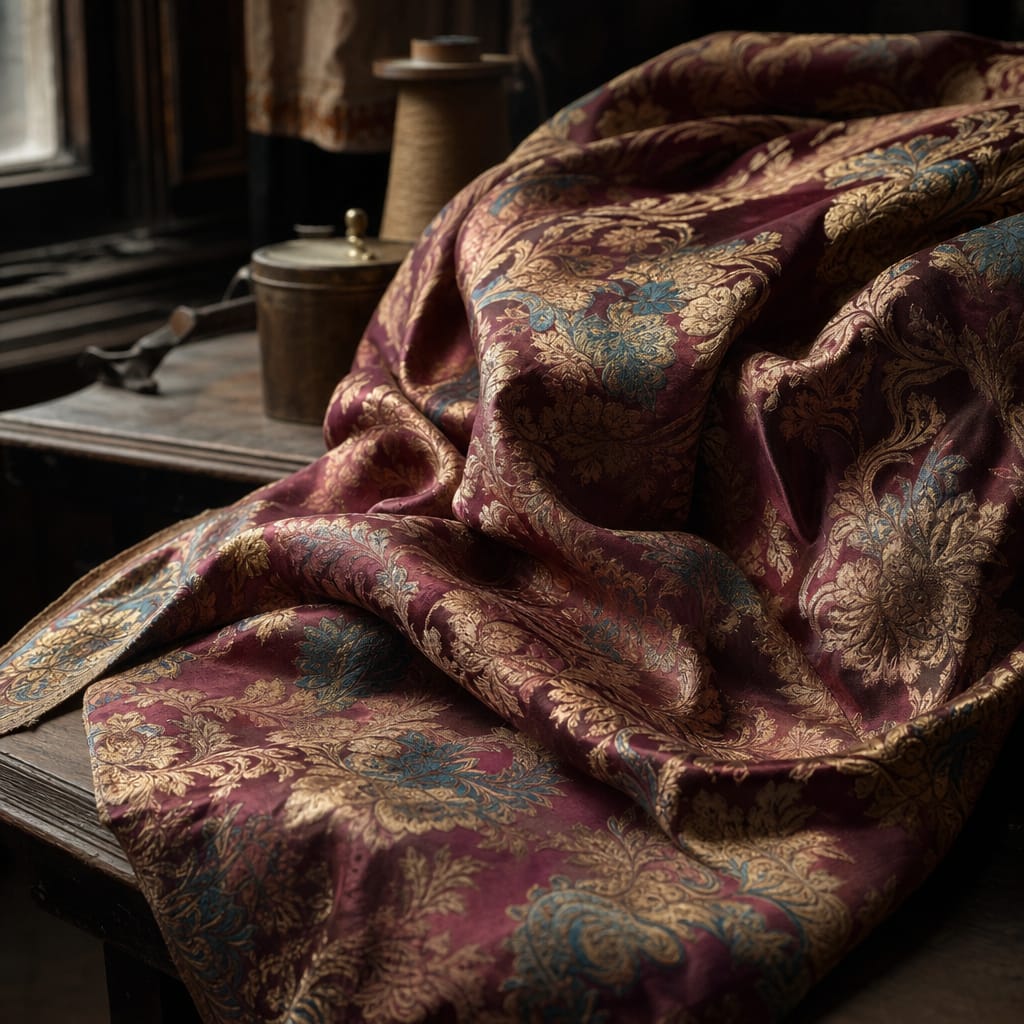
These Spitalfields weavers transplanted the system whole. They have their sample books — collections of small woven swatches showing the coming season's patterns — which they show to trade buyers before the cloth is even woven in bulk. The market is organised around the concept of the new collection and a rhythm of seasonal previews is built up, in a way that English textile culture had never seen and did not quite have the vocabulary for. Contemporary writers noted the practice with genuine confusion, as though watching a foreign custom they couldn't quite explain.
What the Huguenots had essentially done was separate the value of cloth from its physical qualities and attach it instead to its timing. A silk could be technically perfect and commercially dead simultaneously. That was the invention.
The Infrastructure Underneath Every Trend
The specific mechanism they built, the sample book, the trade preview, the seasonal release and the implicit social penalty for wearing last season's pattern, is extraordinarily transferable. It did not stay in silk.
By the mid-eighteenth century, wallpaper manufacturers were operating on almost identical principles, issuing new colourways at regular intervals and making the previous run feel dated. Furniture makers followed. Ceramic pattern books worked the same way. The skeleton was always the same: advance samples, a fixed season, and the quiet suggestion that to be caught behind the cycle was to have announced something unflattering about yourself.
For UK trend analysis across industries, sites like https://www.valaura.co.uk/ track how that same rhythm now moves across sectors from interiors to food to digital culture.
This same structure had by the twentieth century been industrialised in pop music, as release schedules and chart cycles do for sound what the Spitalfields weavers had done for colour. The language changed – "chart position" instead of "new season" – but the underlying idea, that there is a correct moment for a thing and that moment has an expiry, is that brought by a French refugee to East London in the 1690s, when his religion made him unwelcome at home.
What the Word Itself Was Doing
Which brings us back to the word. “Trend” comes from the Old English trendan – to revolve, to roll in a circle. Not to progress. Not to advance. To go around. So the people who turned it into a commercial concept may not have known the etymology, but they built something that illustrated it perfectly anyway: a wheel turning on a fixed schedule, making last season’s silk into this season’s embarrassment, and this season’s embarrassment into next season’s nostalgia.
The wheel has been turning for three hundred and forty years. Still, underneath it all, it is the same wheel that the Huguenots built in Spitalfields. They had to go somewhere when France did not want them.
FAQ
Who were the Huguenots and why did they come to Britain?
The Huguenots were French Protestant silk weavers who fled from France in 1685 when Louis XIV revoked the Edict of Nantes, and their religion became prohibited in France. Eventually around fifty thousand Huguenot refugees arrived in Britain and a large proportion of them settled as silk weavers in the area of Spitalfields just outside the old City of London wall. They brought with them the most advanced textile industry in the world.
What is pattern obsolescence in the silk trade?
Pattern obsolescence, a practice where designs are withdrawn from sale on a schedule, even though the fabric is not worn out or ugly, is an example from the Lyon silk trade, where many of the fleeing Huguenots came from. There, novelty was more profitable than durability and thus designs were introduced at fixed intervals. This means that technically perfect silks could become commercially worthless.
What were Huguenot sample books?
Sample books of Spitalfields weavers were collections of small woven swatches which demonstrated the coming season’s fashion. The weavers would display them to trade buyers prior to the bulk of the fabric being made, organising the market around the new season’s collection and a series of seasonal previews – previously unknown to English textile culture and for which there were no words.
Where does the word trend come from?
Trend comes from the Old English word trendan meaning to revolve or roll in a circle, not to progress or advance. The wheel of commerce was organised by the Huguenots into a regular round on a fixed schedule, in which last season’s style becomes an obsolete embarrassment, and it has turned for three hundred and forty years.