


Somewhere in London in 1974, a fashion editor was having lunch with a buyer from John Lewis. By the time they'd finished their wine, the colour of next spring's cardigans had been quietly decided. Not for them personally – for roughly everyone. That's not a conspiracy theory, it's just how it worked.
Trends in Britain used to be a committee decision. A very small committee. Mostly eating in the same restaurants.
The Closed Room Where Next Year Was Made
The machinery was remarkably compact. A handful of magazines – Vogue, Harper's, a few trade titles most people never read – employed fashion editors who attended the same Paris and Milan shows, wrote up the same conclusions, and fed them to the buyers at Marks & Spencer, House of Fraser, C&A. Those buyers then placed orders. That was that. What appeared in the shops twelve months later wasn't random. It was the result of a fairly legible chain of human decisions, made by people you could, in theory, have identified by name.
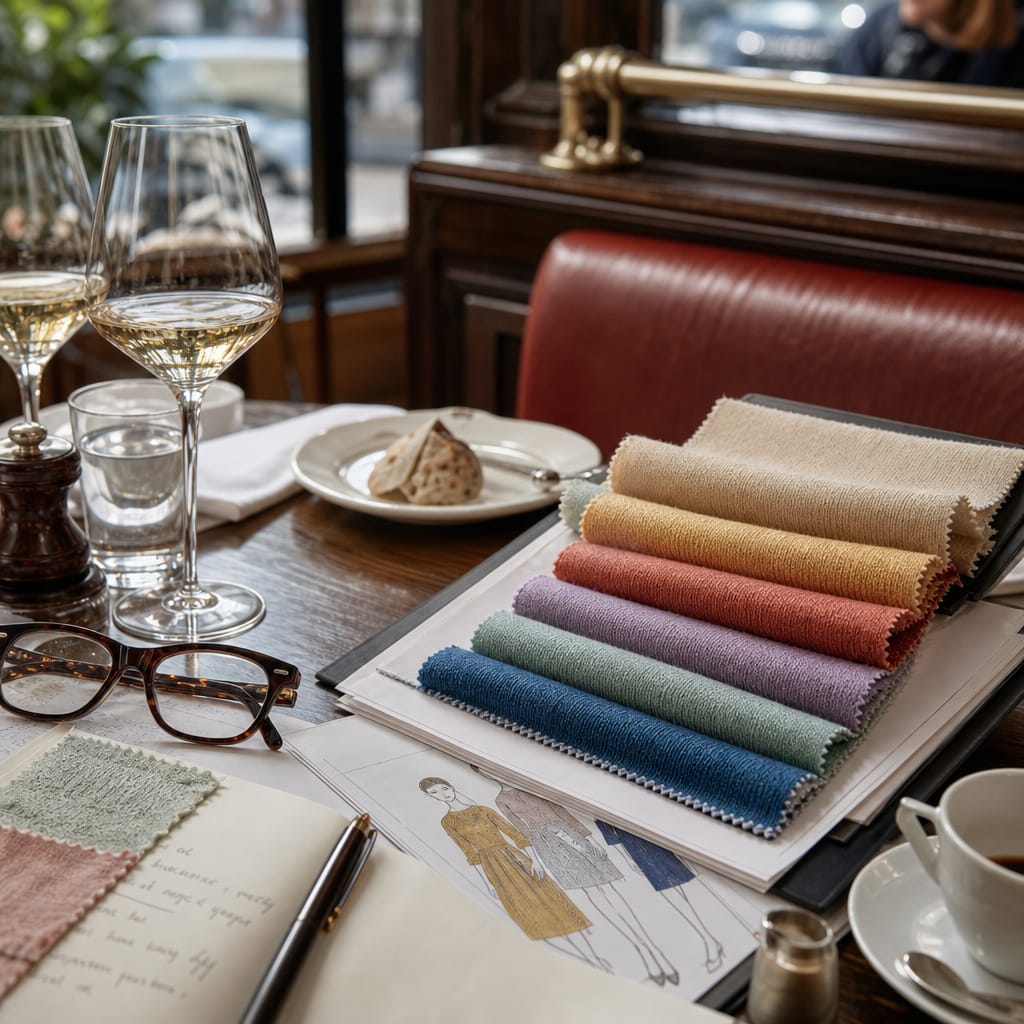
The trade fairs made it even tidier. Events like Première Vision in Paris existed specifically so that fabric manufacturers, designers, and retailers could be in the same room, see the same sample books, and reach something close to consensus. A colour or a silhouette would be agreed upon – sometimes almost literally agreed upon, by colour forecasting agencies who produced expensive reports telling the industry what they'd all decided to agree was coming next.
It sounds almost charmingly old-fashioned. But it had one quality that the current system entirely lacks: you could see it. You could disagree with it. If you were bolshie enough, you could ignore it entirely.
The Illusion of the Bottom-Up Trend
The story we tell ourselves about how trends work now is much more democratic. Millions of people post things, watch things, share things. Somewhere in that enormous warm noise, certain ideas rise. The tote bag. The Stanley cup. The whatever-is-happening-right-now on your For You page. It feels grassroots, spontaneous, alive.
It's mostly an illusion.
What's actually happening is that a recommendation algorithm – the one inside TikTok, Instagram, YouTube, or whichever platform has most of your attention this year – is making decisions about what to show you. And unlike the fashion editor finishing her Chablis, the algorithm doesn't have a name, doesn't publish its reasoning, and can't be rung up to ask why it's suddenly obsessed with mushroom foraging or vintage linen or whatever aesthetic it is currently amplifying to thirty million people simultaneously.
The old system was narrow by accident – there simply weren't many gatekeepers. The new system is narrow by design, and the gatekeeping is done by code that its own creators only partially understand. A video gets a little traction, the algorithm promotes it, it gets more traction because the algorithm promoted it, the algorithm promotes it further – and three weeks later there's a trend, and it looks organic because no individual person chose it. But something chose it.
What the Trend Economy Runs On
There's a further twist. The apparent chaos of the current system has produced an enormous industry dedicated to predicting and creating trends: social listening agencies, microtrend analysts, creators who are paid to seed aesthetics before they officially exist. The 1970s had colour forecasting agencies producing expensive reports. Now there are TikTok strategy decks doing exactly the same job, dressed up in different language.
The differences are real. Trends move faster now – a genuine aesthetic can rise and feel exhausted within a year, sometimes months, where a 1970s silhouette might have had a three or four year runway. There are also more simultaneous trends, because the algorithm learns your specific preferences and sends you down a narrower corridor. Your For You page and your colleague's may have almost nothing in common.
But the fundamental shape – a small number of actors with outsized influence, making decisions that feel inevitable by the time they reach you – hasn't really changed. The committee is still there. It just doesn't eat lunch.
Knowing this won't change anything you buy or wear. But trends can feel like collective human instinct, like something welling up naturally from the culture – and sometimes they are. Mostly, though, they're an output. And there's a machine producing them, even if you'll never read its minutes.
FAQ
Who decided fashion trends in Britain before social media?
It was decided by a very small group of people. The fashion editors from magazines such as Vogue and Harper’s would attend the same shows in Paris and Milan and then go to see the buyers from Marks & Spencer, House of Fraser and C&A to tell them what they thought of the shows, and the buyers would then place their orders for the necessary stock for their shops.
What was the role of trade fairs like Première Vision?
People from fabric producers, designers and retailers were brought together in one room to view the same sample books and try to reach something close to a consensus. Colour forecasting agencies delivered expensive reports about future developments in the market for colours and silhouettes. On the basis of these reports a decision was effectively taken in advance, which was then valid for the entire industry.
Are social media trends really spontaneous?
Mostly not. Most of what gets shown on platforms such as TikTok, Instagram and YouTube comes from recommendation algorithms. In some cases videos gain a little traction organically before the algorithm starts to promote them, and they grow because of that promotion, but after three weeks the video looks organic even though no one has actually chosen it individually.
How are modern trends different from 1970s trends?
A lot of trends are moving faster and there are more of them at once. So where a 1970s silhouette trend, for example, might have lasted three or four years, an aesthetic can be ‘trended’ to exhaustion within a year or even in some cases within months. In addition the algorithmic feeds of For You pages on platforms are tailored towards the individual user. As a result the For You pages of two individuals can contain almost entirely different sets of aesthetics and trends.