


Take a handful of change out of your pocket. Look at the brown pennies, the fifty pence pieces, and the thin five pee coins. They all look like money. But each of them is also a small disc of commodity metal, with a spot price which has absolutely nothing to do with the number stamped on the front.
No one ever explains this about saving money, and it is genuinely strange that the pound in your pocket is a physical object made of real materials and has a 'spot price' which has nothing to do with the face value. The market value of what your money is actually made of fluctuates on a global market with mining output, geopolitical wobbles and Chinese manufacturing demand. The face value of a coin and its market value are two completely different numbers and have been in a slow, grinding war throughout British history.
The Arms Race Under Your Sofa Cushions
In British pennies made of copper from 1797 to 1992 the copper was proper copper, i.e. the same stuff as in central heating pipes. The price of copper does not stand still – it rises, it falls – and it surges when a new economy is just starting to build its infrastructure.
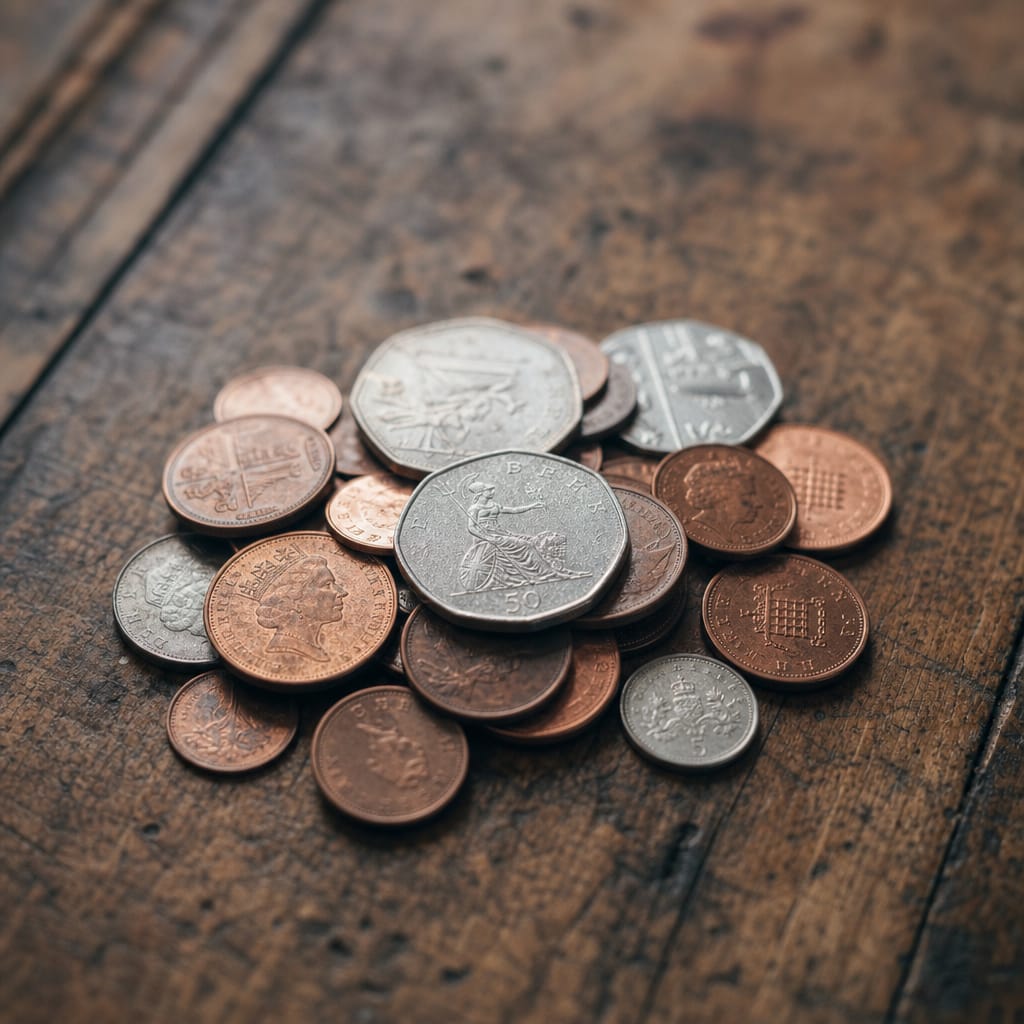
For long stretches of the twentieth century the copper in a penny cost a tiny fraction of one penny – comfortably, pleasantly below face value. The Royal Mint made a profit on every coin it issued, which is called seigniorage – and everyone was happy.
Then global copper prices climbed. By the early 1990s, the arithmetic was getting uncomfortable. The copper in a one-penny coin was approaching a meaningful fraction of that coin's declared worth, which creates an obvious problem: if the metal becomes worth more than the face value, people stop spending the coins and start melting them. It's illegal to melt British coinage, but the economic incentive is very real, and this exact thing has happened repeatedly across history – particularly with silver coins in wartime, when demand for the metal spiked and perfectly good sixpences started disappearing from circulation.
The Royal Mint's solution in 1992 was elegant and slightly cheeky: they kept the coins looking copper but quietly switched the insides to steel and applied a thin copper plating over the top. Your modern penny is basically a small tin of baked beans wearing a copper Halloween costume.
When Your Small Change Was Worth More Than It Said
Pre-decimal silver coins had real silver in them. These coins were tradeable and assayable. During the First World War, with demand for silver rising and the government needing the metal for industrial purposes, coins with silver in them were hoarded so widely that the Treasury were having to debase the silver content of the coins to keep them in circulation rather than in people's drawers.
By 1947 British coins that had previously been 50% silver had dropped to zero, and were now cupro-nickel. The silver in coins had been worth too much to keep leaving in people's pockets.
This happened in America with quarters and dimes around 1965 for the same reason. It happens everywhere, eventually. The metal wins.
What This Means for Saving
And here's an interesting implication when thinking about money. The cash you save is a commodity that has, in living memory, been ‘debased’ at least twice to stop its raw material value exceeding its face value. The coins you have in your jar are evidence of inflation, of policy decisions and of mining economics pressed into a disc.
The two pence at the bottom of your jar is worth less than it used to be in terms of what you can buy with it, but it isn’t made of the same materials as it used to be. It’s been changed to cheaper materials, all without telling you.
While saving money isn’t pointless, it does help to understand that money is a manufactured object with a supply chain running from a Chilean copper mine to the presses of the Royal Mint at Llantrisant. Money is not neutral, it is not abstract. Two pence are a piece of metal that someone decided to call two pence on a day when two pence made sense.
Your loose change in the cupholder of your car has a history. It doesn’t feel the need to mention it.
FAQ
Why did the Royal Mint change the penny in 1992?
The penny was changed by The Royal Mint in 1992 as the cost of copper was reaching a meaningful fraction of the face value of the coin and people could have melted the coins for the value of the copper in them. A steel core with a thin layer of copper was used to make the coins look like copper at a lower cost.
Is it illegal to melt British coins?
Yes, it is against the law to melt British coins, but there is a very real incentive to do so when the coin contains metal worth more than its face value. Silver coins have been melted on many occasions, particularly during wartime when their metal content becomes more valuable, with sixpences known to ‘vanish’ from circulation.
When did British coins stop containing silver?
By 1947, British coins previously made with 50% silver were now made with cupro-nickel. The demand for silver had increased during the First World War and coins were being hoarded. In order to maintain their circulation the coins were debased by the Treasury.
What is the spot price of a coin?
The “spot price” of a metal is the current price of that metal on the global market. It can fluctuate based on a variety of factors including the amount of the metal that is mined, global politics, and the manufacturing demands of countries like China. The face value of a coin and its market value are two different numbers.